
As industrial automation systems evolve toward higher levels of intelligence and connectivity, the role of the human–machine interface (HMI) remains fundamental. Operators still rely on displays to interact with machines, monitor system status, and respond to real-time data. While screen technologies continue to advance, one display size has remained consistently relevant across decades of industrial development: the 7-inch industrial LCD display.
In factories, process plants, and embedded control systems, the 7-inch form factor—often paired with an 800×480 resolution—has proven to be an optimal balance between usability, integration efficiency, and long-term reliability. Solutions such as this 7-inch 800×480 industrial control LCD module illustrate why this display size continues to be widely adopted in industrial environments.
This article explores why 7-inch displays remain the standard interface size for industrial control panels and how they align with modern industrial system requirements.
Industrial HMIs are fundamentally different from consumer displays. Instead of entertainment or visual immersion, their purpose is clear communication between humans and machines.
Operators need to:
View machine states and operational data quickly
Identify alarms or faults without ambiguity
Navigate system menus efficiently
Perform repetitive tasks without fatigue
The 7-inch display size provides enough physical space to present structured information while remaining compact enough for embedded systems. It allows text, icons, and indicators to be displayed at comfortable sizes without overcrowding the interface.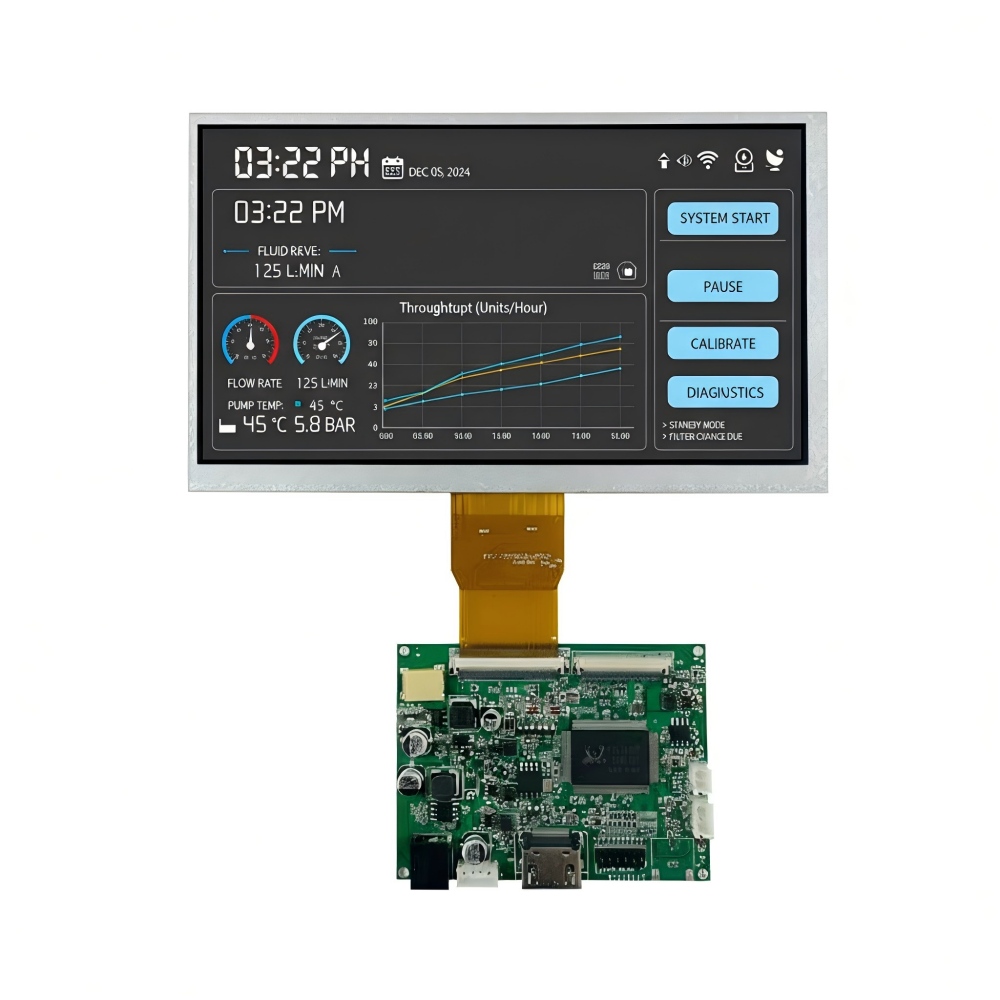
From an ergonomic perspective, 7-inch displays align well with typical industrial panel layouts.
Most industrial control panels are viewed from short distances—usually arm’s length or closer. A 7-inch screen:
Is easily readable without excessive head movement
Reduces eye strain during long operation shifts
Supports both standing and seated operator positions
Larger screens may introduce unnecessary visual scanning, while smaller displays can limit readability. The 7-inch size strikes a practical middle ground.
Industrial control cabinets often have limited space. A 7-inch LCD module allows system designers to:
Integrate displays into compact enclosures
Maintain room for buttons, switches, and indicators
Reduce overall panel size and material costs
This efficiency contributes to cleaner, more serviceable control panel designs.
Resolution choices in industrial systems are driven by function, not trend.
The 800×480 resolution enables:
Clearly rendered numeric values
Legible status messages
Simple graphs and bar indicators
For industrial HMIs, clarity is more important than pixel density. The resolution supports intuitive UI layouts without overloading embedded processors.
Many industrial systems rely on MCUs or low-power processors. Using moderate resolutions like 800×480 helps:
Lower memory requirements
Improve UI responsiveness
Simplify firmware development
This contributes to system stability and long-term maintainability.
The continued popularity of 7-inch displays is closely tied to their adaptability across industrial use cases.
Production equipment often requires localized control interfaces. A 7-inch display allows operators to monitor machine speed, error codes, and process variables efficiently.
PLC-based systems benefit from compact displays that integrate seamlessly into automation cabinets, providing local visualization without relying solely on centralized SCADA systems.
During commissioning or maintenance, technicians use embedded displays to configure parameters and perform diagnostics. A 7-inch interface simplifies this process with clear, structured menus.
Industrial LCD modules in the 7-inch category typically support standard interfaces such as RGB or LVDS. These interfaces are:
Well-supported by industrial control boards
Resistant to signal degradation
Suitable for long-term embedded operation
This compatibility reduces integration risk and shortens development cycles.
Industrial systems are designed for longevity. Displays used in these environments must maintain consistent performance over years of operation. The 7-inch industrial LCD form factor has a long track record of stable supply chains, mature manufacturing processes, and predictable performance.
The continued dominance of 7-inch displays in industrial control panels is no coincidence. Their ergonomic balance, integration flexibility, and proven reliability make them a practical choice for embedded HMIs and automation systems.
Solutions like the 7-inch 800×480 industrial control LCD module reflect the design principles that industrial engineers continue to value: clarity, stability, and efficiency.

