Selecting the right TFT LCD module for an embedded product requires more than simply choosing a screen size. Engineers need to consider resolution, brightness, interface, mechanical dimensions, operating temperature, viewing characteristics, backlight technology, and system compatibility.
The DBT057GQN40R080A is designed around a 5.7-inch TFT LCD panel with a 320×240 pixel resolution and a 40-pin RGB interface. Its 800 cd/m² brightness makes it particularly suitable for applications where a conventional 250–400 cd/m² display may not provide sufficient visibility.
The module uses an LED backlight and supports an operating temperature range of -20°C to +70°C, with a storage temperature range of -30°C to +80°C. These characteristics make it suitable for a broad range of industrial and commercial embedded equipment.
The product is also part of Aptus Display's broader TFT LCD portfolio, which includes displays using RGB, LVDS, MIPI and other interfaces, as well as different resolutions, sizes, brightness levels, temperature ranges and touch configurations.
The 5.7-inch screen size offers a useful balance between display area and equipment footprint. It provides enough space for displaying operating parameters, menus, measurement values, status indicators, graphical interfaces and other information while remaining suitable for relatively compact equipment.
For industrial control equipment, handheld instruments and vending or kiosk systems, this form factor can provide a practical alternative to significantly larger displays.
The 320×240 resolution is well suited to embedded applications where the primary objective is clear presentation of operational information rather than high-resolution multimedia content.
The QVGA-class resolution can support:
Numerical data
Equipment status information
Simple graphical interfaces
Icons and indicators
Measurement results
Menus and control functions
Basic charts and diagrams
Machine operating parameters
For an industrial HMI or instrumentation project, selecting a resolution appropriate to the information being displayed can also help control system cost and processor requirements.
One of the key characteristics of this display is its 800 cd/m² brightness.
Higher luminance can improve display visibility when ambient illumination is stronger. This makes the module suitable for equipment installed near windows, in bright workshops, semi-outdoor environments, and selected outdoor applications.
However, 800 cd/m² should not automatically be interpreted as fully sunlight-readable. Direct sunlight applications may require additional optical design measures such as anti-glare treatment, optical bonding, improved cover glass design, or higher-brightness backlighting depending on the installation environment.
This distinction is important when engineers specify displays for outdoor equipment.
The module uses a 40-pin RGB interface.
RGB interfaces are commonly used in embedded display systems where the host processor or display controller provides a parallel RGB display output.
Before integration, engineers should verify the host controller's RGB timing, color depth, pixel clock, synchronization signals, voltage levels, FPC pin assignment and initialization requirements against the latest module documentation.
Interface matching should always be completed before PCB design is finalized.
The module uses an LED backlight, providing the illumination required for the TFT panel.
For system integration, engineers should evaluate the backlight supply requirements, current control, thermal conditions and expected operating lifetime as part of the complete display subsystem.
The specified operating temperature range is -20°C to +70°C, while the storage temperature range is -30°C to +80°C.
This temperature specification allows the module to be considered for industrial equipment and other applications exposed to moderate temperature variation.
For projects operating continuously at the upper or lower limits, the complete system should still be evaluated for thermal management, enclosure conditions and actual environmental exposure.
| Specification | Details |
|---|---|
| Product Name | 5.7 Inch 320×240 40-Pin RGB TFT LCD Module |
| Model | DBT057GQN40R080A |
| Display Size | 5.7 Inch |
| Resolution | 320 × 240 dots |
| Display Type | TFT LCD |
| Interface | RGB |
| Interface Pin | 40 Pin |
| Brightness | 800 cd/m² |
| View Direction | 65/65/50/65 |
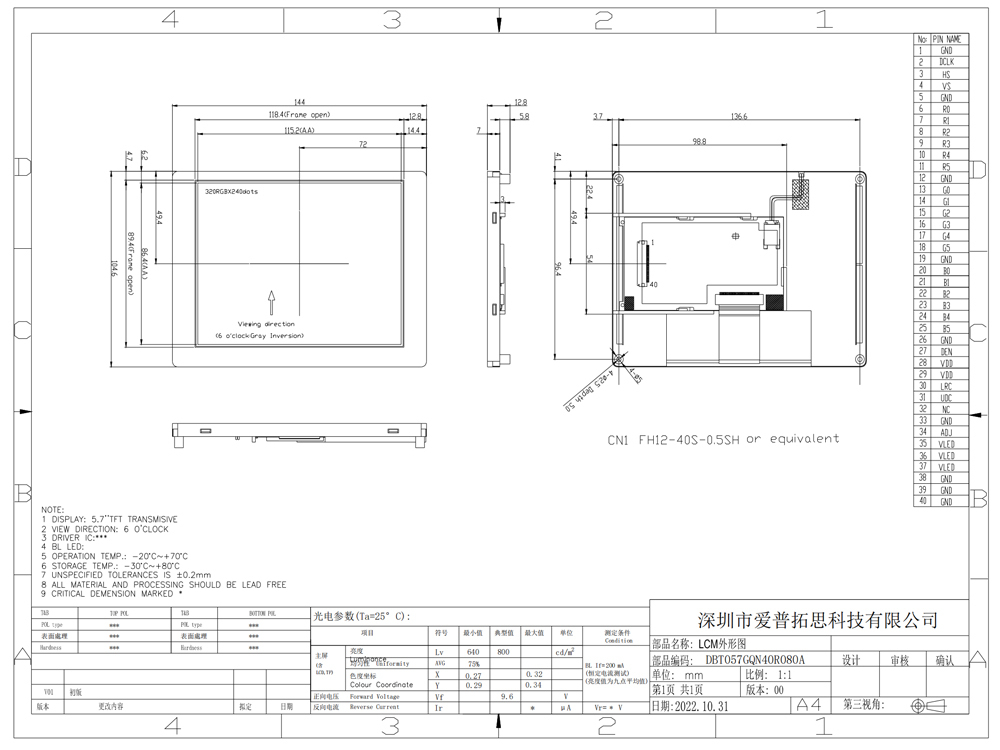
| Active Area | 86.4 × 115.2 mm |
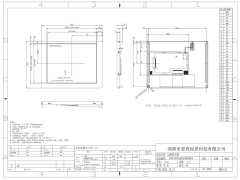
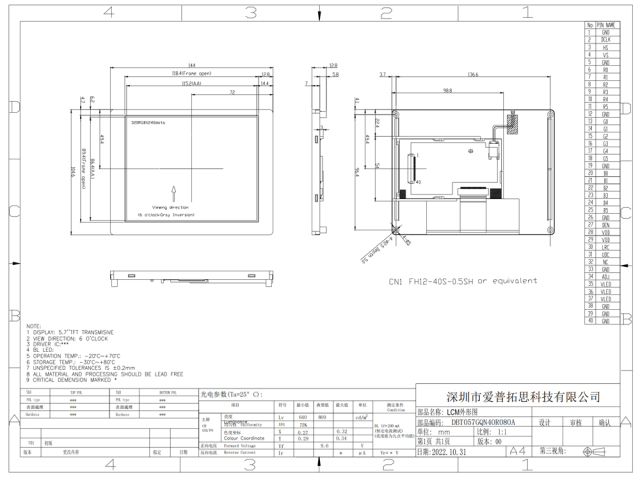
| Module Dimension | 104.6 × 144.0 × 12.8 mm |
| Backlight | LED |
| Operating Temperature | -20°C to +70°C |
| Storage Temperature | -30°C to +80°C |
| Touch Panel | Not specified as standard configuration |
| Application | Industrial, instrumentation, kiosk and embedded equipment |
The specifications above are based on the information published on the Aptus Display product page and TFT LCD catalog.
Engineering note: The current product page displays the dimensional fields as “Active Area: 86.4×115.2 mm” and “Module size: 104.6×144.0×12.8 mm.” Before production, customers should confirm the mechanical drawing and latest datasheet with Aptus Display, particularly when designing the mounting structure or enclosure.
Industrial control equipment often needs a reliable display for operating parameters, alarms, machine status, process information and control menus.
The 5.7-inch format provides sufficient viewing space for a compact HMI while avoiding the larger footprint of a 7-inch or 10.1-inch display.
The 800 cd/m² brightness can also be beneficial for industrial environments with strong ambient lighting.
Typical applications include:
Machine control panels
Factory automation equipment
Process control interfaces
Industrial monitoring equipment
Equipment status displays
Embedded HMI terminals
Aptus also maintains a dedicated industrial display category and technical content covering display selection, brightness, temperature, interface and touch-panel considerations.
Outdoor kiosks need displays that remain visible under changing lighting conditions.
The 800 cd/m² backlight provides higher luminance than many conventional indoor TFT displays, making this module a candidate for selected outdoor or semi-outdoor kiosk applications.
Potential uses include:
Information kiosks
Self-service terminals
Parking equipment
Access-control equipment
Ticketing machines
Public information terminals
For direct sunlight installations, engineers should conduct actual readability testing because brightness alone does not determine sunlight readability.
Vending equipment requires compact displays capable of presenting product information, pricing, machine status and user instructions.
The 5.7-inch form factor can fit applications where cabinet space is limited, while 800 cd/m² brightness can improve visibility in bright commercial environments.
The current Aptus product page specifically identifies outdoor kiosks and vending machines as application scenarios for this module.
Measurement devices frequently require compact displays for numerical readings and operating information.
The 320×240 resolution can provide an efficient interface for:
Digital meters
Test instruments
Portable measurement equipment
Inspection tools
Field-service equipment
Data acquisition devices
The -20°C to +70°C operating range can also support equipment used across different working environments.
Instrumentation applications often prioritize readability, reliability and integration simplicity over multimedia-level resolution.
This TFT module can be considered for embedded instrumentation where the display needs to present values, indicators, warnings, menus and graphical information.
The combination of 5.7-inch size, 320×240 resolution, 800 cd/m² brightness and 40-pin RGB connectivity gives this module a specific advantage for embedded equipment that needs a brighter display without moving to a significantly larger screen.
Compared with a conventional lower-brightness TFT LCD, an 800-nit configuration provides greater luminance headroom for bright environments.
At the same time, the 320×240 resolution can be sufficient for control-oriented interfaces and can avoid unnecessary processing and rendering requirements associated with higher-resolution panels.
For OEM and ODM engineers, this balance can be particularly useful when designing products with:
Limited enclosure space
Existing RGB display architecture
Moderate graphical requirements
Bright ambient lighting
Industrial operating conditions
Cost-sensitive system designs
When integrating the DBT057GQN40R080A into a new product, several factors should be checked before final PCB and enclosure design.
The host processor must support the required RGB interface configuration. Engineers should confirm signal timing, color format, pixel clock, synchronization signals and electrical characteristics.
The published module dimensions are 104.6 × 144.0 × 12.8 mm.
The final mechanical design should allow sufficient tolerance for the LCD, FPC, connector and mounting structure.
The 800 cd/m² brightness is a major feature of this module. However, the actual optical performance depends on ambient lighting, cover glass, surface treatment, viewing angle and installation geometry.
For outdoor applications exposed to direct sunlight, an engineering sample should be evaluated in the actual installation environment.
High-brightness displays can generate more heat depending on backlight configuration and operating conditions.
The enclosure should provide appropriate thermal paths, particularly for products operating continuously at elevated ambient temperatures.
The published operating range is -20°C to +70°C.
If the target equipment requires operation outside this range, customers should discuss a wide-temperature alternative with Aptus Display.
Not every project can use a standard LCD module. Mechanical constraints, interface requirements, touch functionality, brightness targets and environmental conditions can vary significantly between products.
Aptus Display offers standard, semi-custom and total custom LCD solutions. Its capabilities include adding connectors, ZIF and FPC configurations, touch panels, interconnect solutions, control boards and system-integrated solutions.
This allows customers to approach display development from the system level rather than treating the LCD as an isolated component.
For example, an OEM project may start with a standard 5.7-inch TFT LCD and later require:
A different FPC configuration
Customized connector positioning
Touch panel integration
Higher brightness
Different viewing requirements
Modified mechanical dimensions
A compatible control board
Custom cable solutions
Discussing these requirements during the early engineering stage can reduce integration risks and help establish a more suitable production configuration.
Aptus Display is a professional LCD display supplier and manufacturer serving international customers with TFT LCD modules, customized display solutions, touch panel products, industrial displays and application-specific display systems.
Its product portfolio covers multiple display technologies and sizes, including TFT LCD modules, AMOLED displays, touch panel LCD modules, bar-type displays, flight simulator displays, wide-temperature displays and other specialized solutions.
Aptus focuses on supporting OEM and ODM customers through:
LCD display selection
Product customization
Engineering integration
Touch panel solutions
FPC and connector solutions
Control-board development
Sampling
Mass production
Global delivery
The company's TFT LCD portfolio includes multiple RGB, LVDS and MIPI display configurations, allowing customers to compare display solutions based on size, resolution, interface, brightness, temperature range and touch requirements.
For B2B customers, this product-development approach can be useful when a standard display needs to be adapted to specific mechanical or electrical requirements.
The display resolution is 320×240 pixels. This resolution is suitable for industrial control interfaces, instrumentation, measurement equipment and other applications where numerical and graphical operating information is the primary content.
The DBT057GQN40R080A uses a 40-pin RGB interface. Engineers should confirm the host processor's RGB timing and electrical requirements against the latest technical documentation before PCB development.
The module has a specified brightness of 800 cd/m², making it suitable for applications requiring higher luminance than standard indoor TFT LCD modules.
The module is listed for outdoor-related applications such as kiosks and vending machines, and its 800 cd/m² brightness can improve visibility in bright environments.
However, 800 cd/m² does not by itself guarantee direct-sunlight readability. For full outdoor sunlight applications, optical bonding, anti-glare treatment, higher brightness or other optical improvements may be required depending on the environment.
The specified operating temperature is -20°C to +70°C, while the storage temperature range is -30°C to +80°C.
Yes. Aptus supports standard, semi-custom and total custom LCD solutions, including FPC, connectors, touch panels, interconnect solutions and control boards.
The current product specification does not list a touch panel as part of the standard configuration. If touch functionality is required, customers should specify the required touch panel configuration during the inquiry and engineering stage.
If you are developing an industrial control panel, outdoor kiosk, vending machine, handheld measurement device, instrumentation product or other embedded system, the DBT057GQN40R080A 5.7-inch 320×240 800-nit TFT LCD module can be evaluated as a high-brightness RGB display solution.
👉 Request a quote or sample
📧 Or email us directly: info@aptusdisplay.com
Click here for the complete product catalog