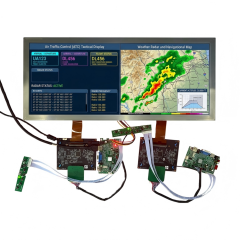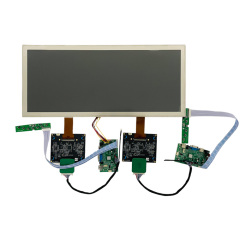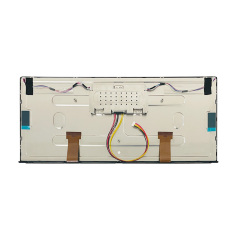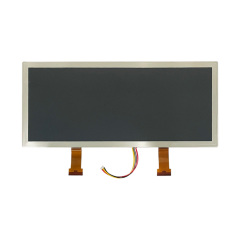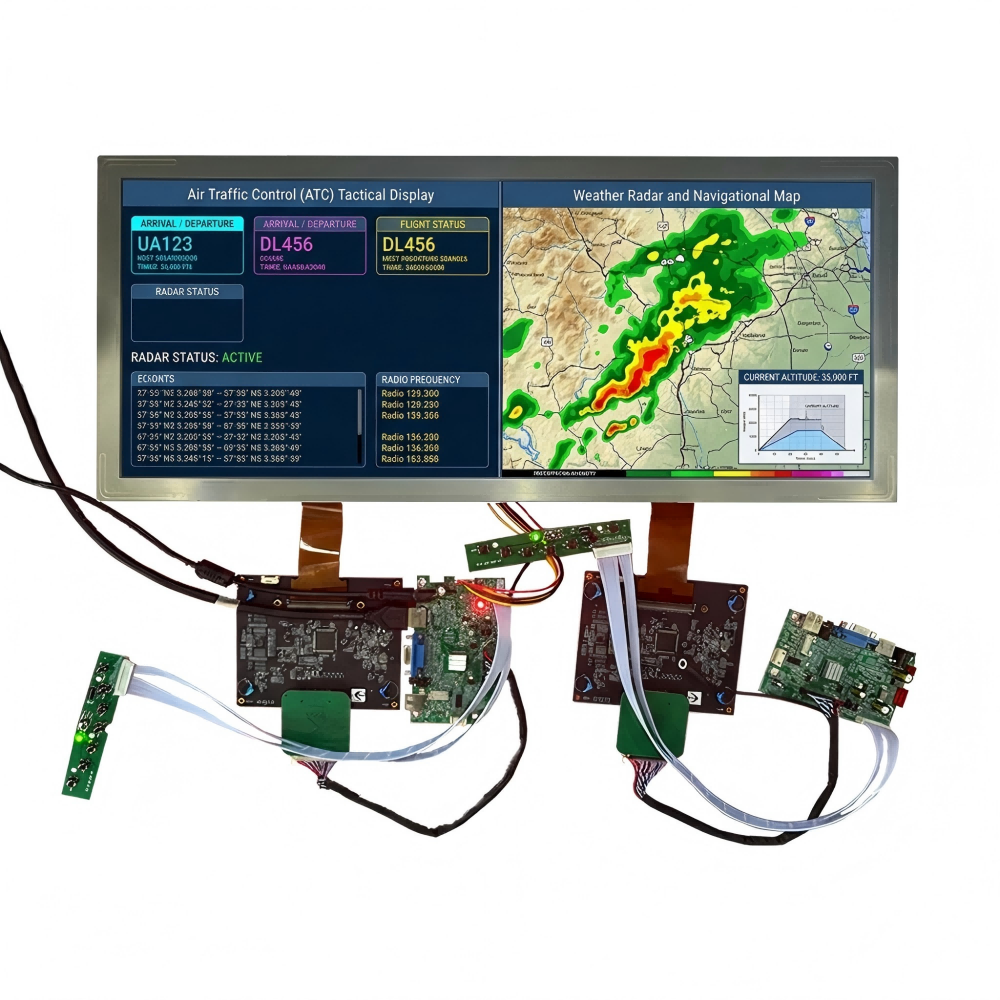
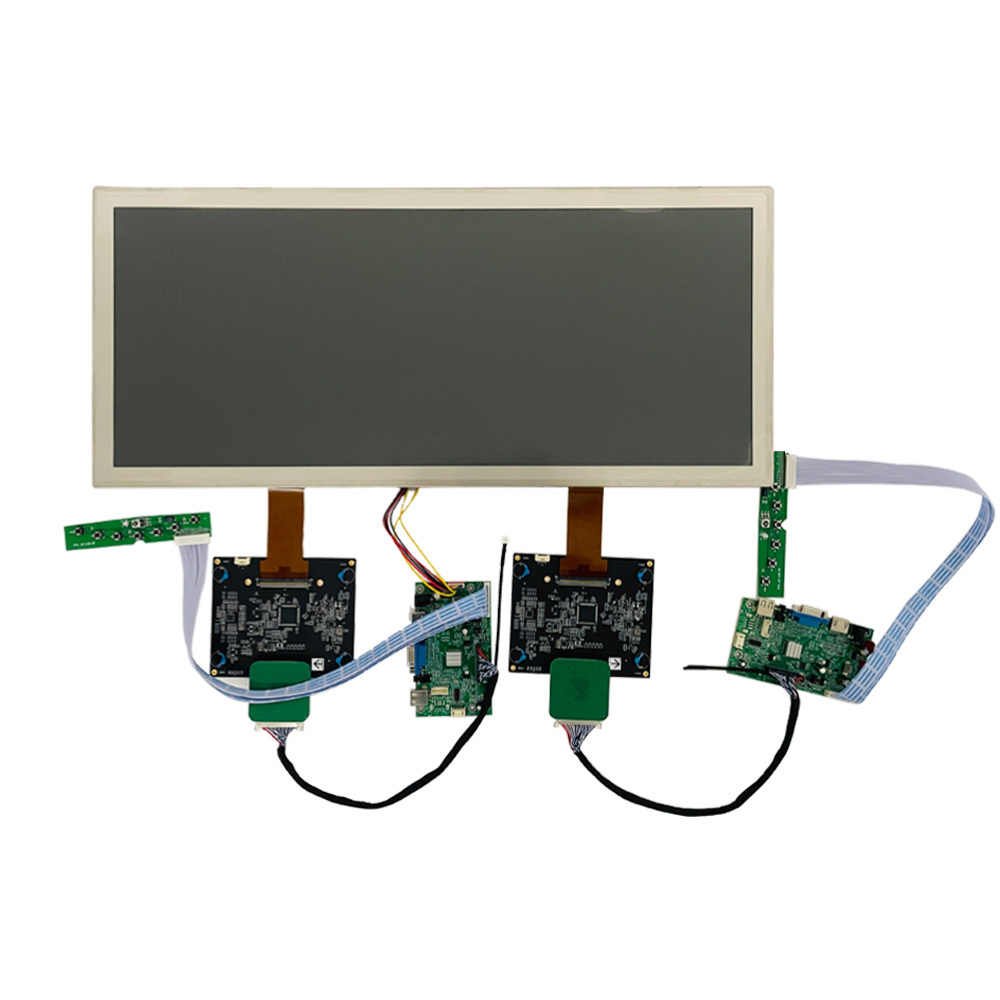
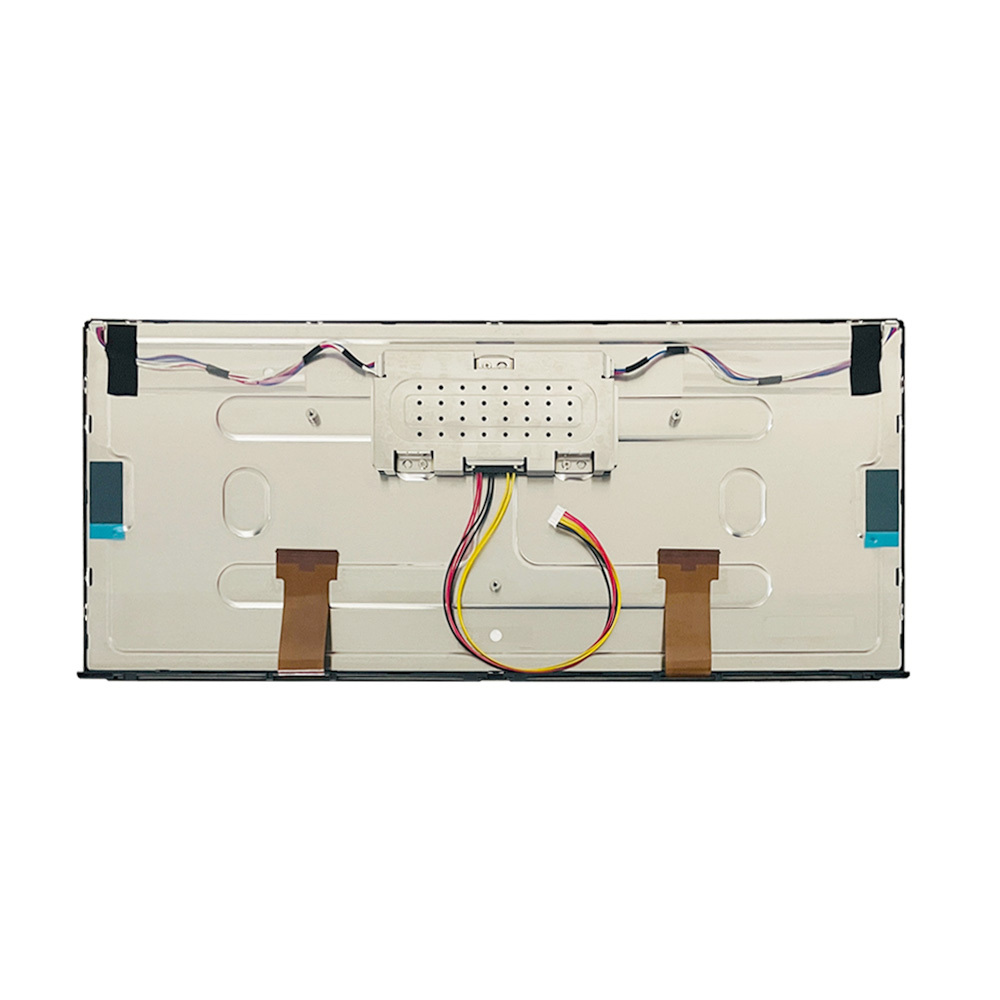
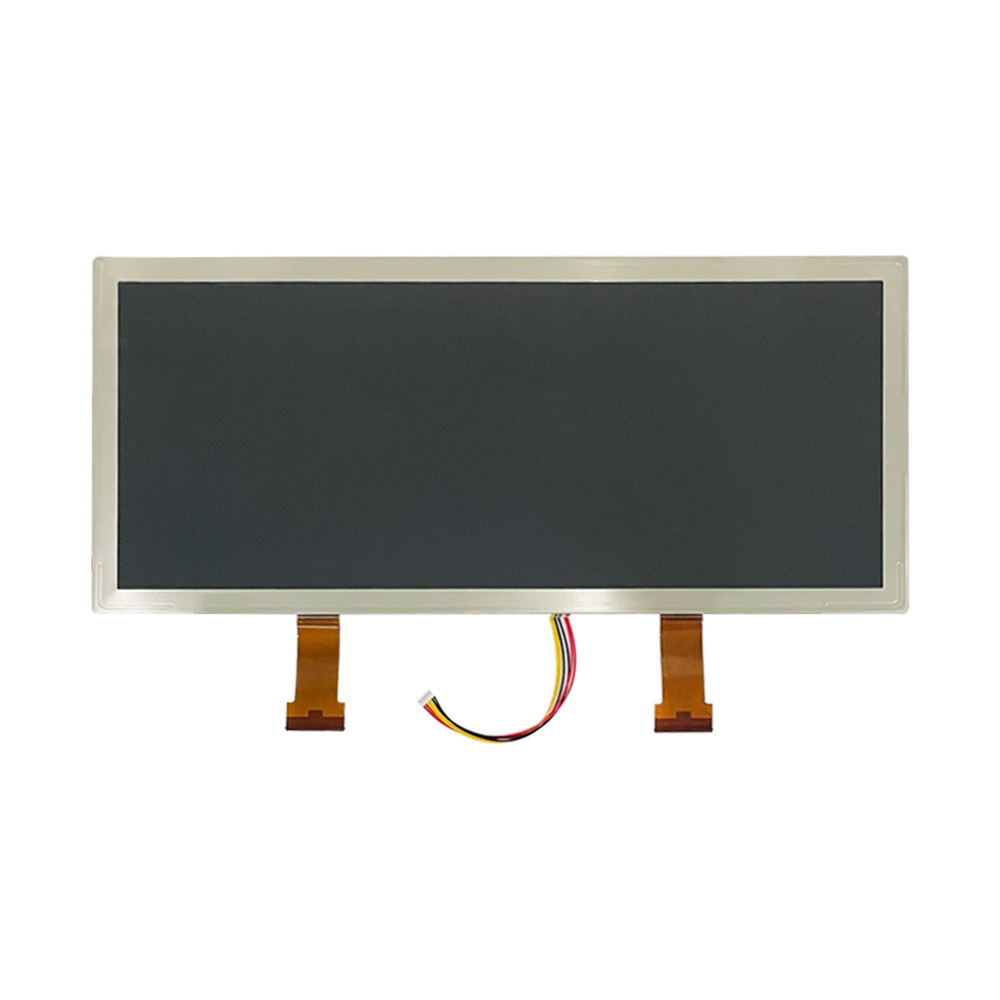
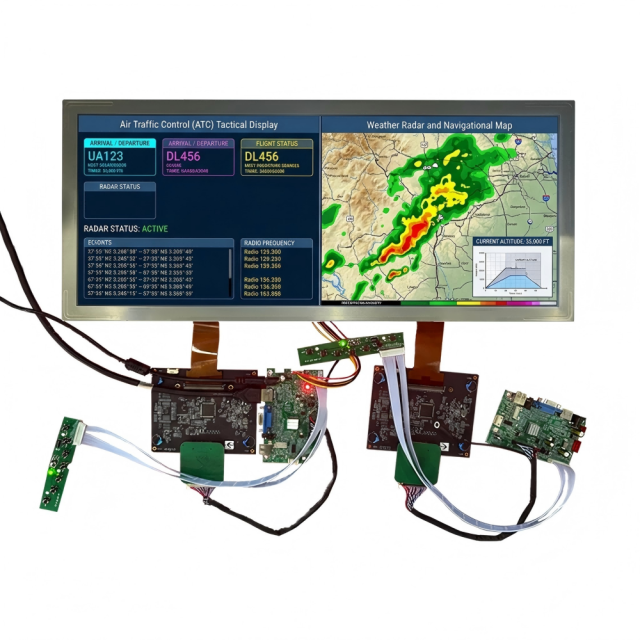
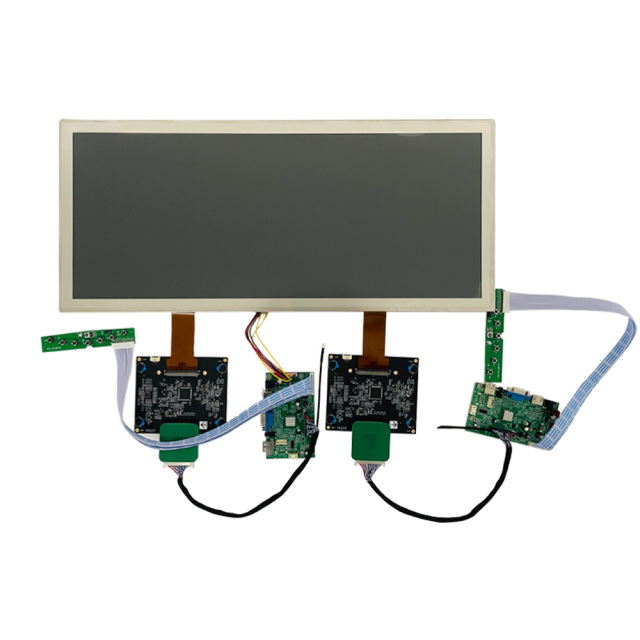
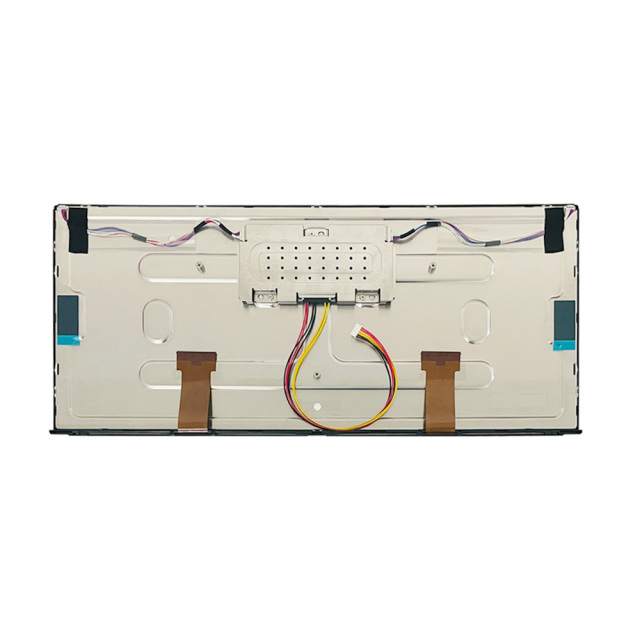
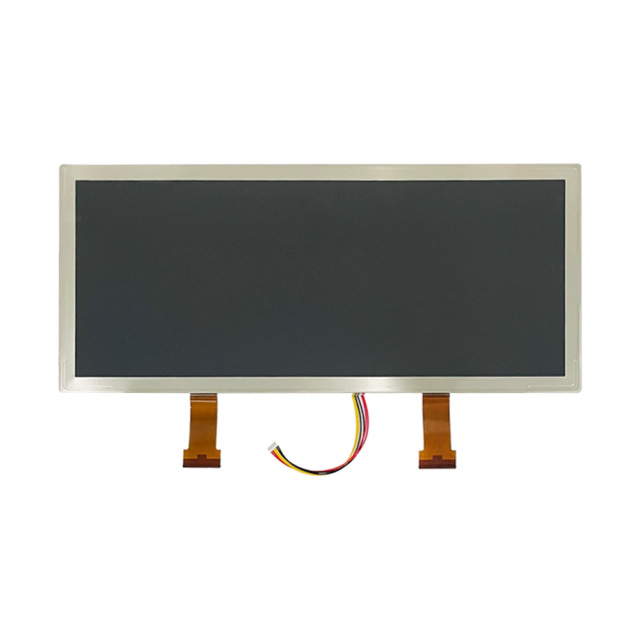
The AS215XDHP01 is an a-Si TFT LCD module with Normally Black technology, offering a high-resolution viewing area of 507.648 × 203.059 mm. With a typical brightness of 900 cd/m² and anti-glare treatment, the display is designed to maintain good image visibility in demanding lighting conditions.
The module provides 80°/80°/80°/80° viewing angles, enabling information to remain visible from different viewing positions. This characteristic is useful in control rooms, vehicle-mounted terminals, tactical consoles, monitoring systems, and industrial equipment where operators may not always sit directly in front of the display.
The display's 2-port LVDS 40-pin interface is one of its most important technical features. It allows system developers to design a dual-view application in which two independent image sources or image areas can be presented simultaneously. For applications such as navigation and surveillance, monitoring and control, or primary and secondary mission information, this architecture can help maximize the available display area.
| Parameter | Specification |
|---|---|
| Product Model | AS215XDHP01 |
| Display Size | 21.5 inch |
| LCD Technology | a-Si TFT |
| Display Mode | Normally Black |
| Resolution | 2560 × 1024 RGB |
| Aspect Ratio | Wide / Custom |
| Active Area | 507.648 × 203.059 mm |
| Module Dimensions | 545.00 × 240.00 × 29.1 mm |
| Pixel Size | 0.1983 × 0.1983 mm |
| Interface | 2-Port LVDS |
| Connector | 40-Pin |
| Color Depth | 16.7M / 24-bit |
| Viewing Angle | 80° / 80° / 80° / 80° |
| Brightness | 900 cd/m² typical |
| Contrast Ratio | Up to 1000:1 |
| Surface Treatment | Anti-Glare |
| Touch Panel | Not included; customizable |
| Operating Temperature | -30°C to +70°C |
| Storage Temperature | -40°C to +80°C |
| Optional Protection | Capacitive Touch Panel + GG5 Cover Glass |
| Application Focus | Defense, security, industrial and professional display systems |
The specifications above are based on the current Aptus product listing and TFT LCD catalog.
The most distinctive advantage of this LCD module is its dual-view capability. Through the 2-port LVDS architecture, a system can be designed to present two independent image areas on one physical 21.5-inch display.
For example, one area can display navigation information while another shows a surveillance feed. In an industrial control system, one side can present machine status while the other displays operating parameters. This approach can reduce the need for multiple physical displays and provide a more efficient operator interface.
The 2560×1024 resolution provides significantly more horizontal pixels than conventional 1920×1080 Full HD displays. The wide format is particularly useful where the application requires multiple information windows arranged horizontally.
For professional equipment manufacturers, this can be useful for designing dashboards that combine graphs, maps, monitoring windows, control information, status indicators, or video feeds in a single display assembly.
With a typical brightness of 900 cd/m², the AS215XDHP01 provides substantially higher luminance than many standard office-oriented LCD modules.
High brightness can improve readability in bright indoor environments and help system designers develop displays for outdoor or semi-outdoor professional applications. The anti-glare surface treatment further helps reduce the impact of reflections on the viewing surface.
Actual outdoor sunlight readability will depend on the complete display system, including cover glass, optical bonding, housing design, ambient lighting, and system brightness control. For demanding outdoor applications, Aptus can evaluate the complete optical configuration according to project requirements.
The module is specified for operation from -30°C to +70°C, with a storage range of -40°C to +80°C. This extended temperature capability makes it suitable for equipment that may experience substantial temperature changes.
Potential applications include rugged vehicle equipment, outdoor control systems, industrial machinery, security equipment, and other professional systems requiring reliable operation beyond typical commercial-office temperature ranges.
The 80° viewing angle specification in all four directions allows operators to view the screen from different positions while maintaining usable image quality.
This is particularly important for shared control environments where multiple operators may need to monitor the same display or where the display is installed at an angle inside equipment.
The wide-format dual-view design can be used in professional defense equipment where operators need to access multiple information sources within a limited dashboard area.
Potential applications include:
Tactical control consoles
Mission information displays
Navigation and surveillance interfaces
Rugged vehicle terminals
Command-and-control equipment
Military communication systems
Situational awareness systems
The module's high brightness, anti-glare surface and wide operating temperature range make it suitable for system-level evaluation in demanding environments.
Security systems often require multiple information sources to be monitored simultaneously. A dual-view display can consolidate different video feeds or combine live surveillance information with system status and control information.
For example, a security terminal could be configured with surveillance information on one side and alarm, access-control, or system-status information on the other.
Radar and monitoring systems often present information in a wide horizontal layout. The 2560×1024 resolution gives designers additional horizontal workspace for graphical interfaces and data visualization.
The dual-view architecture can also support different information streams within one display system, helping operators access more information without adding another physical panel.
The AS215XDHP01 can also be evaluated for industrial automation control panels and professional HMI equipment.
Possible uses include:
Industrial machine interfaces
Process monitoring systems
Factory control terminals
Equipment dashboards
Automation consoles
Remote monitoring equipment
For HMI applications requiring touch input, Aptus can integrate a customized capacitive touch panel according to mechanical and electrical requirements.
The compact physical footprint and wide-format display geometry can be useful in specialized equipment where panel space is limited but multiple information areas are required.
Potential system applications include aircraft simulation equipment, airborne mission interfaces, professional training systems and specialized monitoring consoles.
Actual suitability for airborne or defense-certified equipment should be validated against the complete system's vibration, shock, EMC, environmental and certification requirements.
Aptus provides more than a standard LCD module. The engineering team can support customized display configurations according to the customer's mechanical, electrical and optical requirements.
The standard AS215XDHP01 does not include a touch panel. For interactive applications, Aptus can develop a customized capacitive touch panel solution.
The touch configuration can be designed according to:
Active touch area
Cover glass dimensions
Touch controller requirements
Mechanical mounting
Interface requirements
Glove-operation requirements
System enclosure
For applications requiring additional surface protection, Aptus can support integration of Corning Gorilla Glass 5 (GG5) as an optional cover-glass solution.
A protective cover can improve the durability of the front surface for equipment that is frequently touched or exposed to physical handling. Optical design should be evaluated together with the touch panel, cover glass and bonding process to achieve the required display performance.
Depending on project requirements, Aptus can support customization involving:
FPC redesign
LVDS interface tuning
Connector configuration
Mounting-hole adaptation
Housing integration
Optical enhancement
Touch panel integration
Display cable development
Driver-board integration
Aptus's service model covers feasibility evaluation, sample development, engineering verification and mass-production support.
When integrating a 2-port LVDS dual-view LCD module into a new product, engineers should evaluate more than resolution and connector count.
The display controller or host system must be compatible with the module's 2560×1024 timing and 2-port LVDS architecture. The electrical design should also follow the module's detailed datasheet for LVDS signal assignment, power requirements, timing parameters and backlight control.
Mechanical integration should account for the module dimensions of approximately 545.00 × 240.00 × 29.1 mm and the 507.648 × 203.059 mm active area.
For outdoor or high-brightness applications, system-level optical testing is recommended. The final performance can be affected by cover glass reflection, touch-panel structure, optical bonding, ambient illumination, viewing distance and enclosure design.
Aptus can provide engineering assistance and detailed technical documentation during the sample and integration stage.
Aptus Display is a professional LCD display manufacturer and customized display solution provider. The company focuses on TFT LCD modules, touch panels, display accessories and customized display systems for international customers.
According to Aptus's company information, the business has been active in the LCD display industry since 2007, with R&D, manufacturing and marketing capabilities. Aptus also states that its manufacturing operation has ISO 9001 certification and that its engineering team supports LCD/LCM development and customization.
Aptus's product portfolio includes TFT LCD modules, wide-temperature displays, touch panel LCD modules, flight simulator display solutions, LCD accessories and other customized display products. The company also supports semi-custom and total-custom projects involving connectors, ZIF/FPC solutions, touch panels, interconnects, controller boards and system integration.
For customers developing professional display equipment, this means the LCD module can be evaluated as part of a broader display solution rather than treated as an isolated component.
Aptus can support customers throughout the product-development cycle, from initial technical evaluation to prototype samples and production.
Typical project support can include:
Requirement Analysis: Review display size, resolution, interface, brightness, temperature range, touch requirements and mechanical constraints.
Sample Development: Supply samples for electrical, optical and mechanical verification.
Display Customization: Develop touch panels, cover glass, FPCs, cables, driver boards and mechanical adaptations.
System Integration: Assist with display interface and controller-board compatibility.
Mass Production: Support stable production and long-term project supply.
Aptus also provides customized LCD driver-board development and LCD accessories such as display cables, switch boards, backlight driver boards and key panels.
Its key advantage is the combination of a 2560×1024 wide-format resolution and 2-port LVDS dual-view architecture, allowing a system to display separate information streams on one physical display.
Yes. The product is designed around a 2-port LVDS architecture that supports simultaneous independent left-and-right image display when correctly implemented with a compatible host/controller system. System engineers should confirm the required timing and signal configuration against the module datasheet before integration.
The 900 cd/m² brightness, anti-glare treatment and -30°C to +70°C operating temperature range make it a strong candidate for demanding bright-environment applications. However, final sunlight readability depends on the complete display construction. For direct-sunlight applications, Aptus recommends evaluating the complete optical stack, including touch panel, cover glass and bonding.
Yes. The standard module does not include a touch panel, but Aptus supports customized capacitive touch-panel integration. GG5 protective cover glass can also be considered for rugged applications.
The specified operating temperature is -30°C to +70°C, while the storage temperature range is -40°C to +80°C.
Yes. Aptus supports customization involving touch panels, cover glass, FPCs, connectors, cables, driver boards, mechanical structures and other display-system requirements. Customization feasibility should be confirmed according to project volume and technical requirements.
The module is positioned for defense and security applications and offers features such as high brightness, anti-glare treatment and extended temperature operation. However, the complete equipment must independently satisfy applicable defense, environmental, vibration, shock, EMC and certification requirements. The LCD module itself should not be assumed to carry a specific military certification unless explicitly confirmed by Aptus.
Yes. Aptus supports sample evaluation and engineering development before production. Customers can provide the required application, expected quantity, host interface, mechanical constraints and environmental requirements for technical evaluation.
If you are sourcing a 21.5-inch 2560×1024 dual-view LCD module, the AS215XDHP01 offers a combination of high brightness, wide viewing angles, anti-glare treatment, 2-port LVDS connectivity and extended temperature performance.
Whether you are developing a defense console, security monitoring terminal, industrial HMI, radar interface, rugged vehicle display or specialized control system, Aptus can help evaluate the display at both the component and system level.
👉 Request a quote or sample
📧 Or email us directly: info@aptusdisplay.com
Click here for the complete product catalog