
Flight simulators are essential for pilot training, system development, and avionics research. Accurate visual representation is critical to simulate real-world cockpit conditions, where every instrument and indicator must be precisely rendered. Square LCD displays, such as 6.8-inch 768×768 modules, are particularly well-suited for cockpit panels because their 1:1 aspect ratio allows circular and centrally balanced instruments—like attitude indicators, radar scopes, and navigation displays—to be displayed proportionally without distortion. This enhances training realism and supports effective pilot instruction.
Square LCD displays offer technical features ideal for simulator applications. Their 768×768 resolution provides sufficient detail for accurate rendering of primary flight instruments, multi-function displays, and radar screens. Utilizing LVDS interfaces for square LCD displays ensures high-speed, stable signal transmission even in electrically dense cockpit environments. Uniform luminance, wide viewing angles, and low power consumption allow for prolonged simulator sessions without eye strain or color degradation.
Mechanical considerations are also important. The square form factor simplifies panel symmetry, making it easier to align control knobs, rotary encoders, and push buttons around each display. This structural consistency enhances ergonomics and overall panel aesthetics. Proper thermal management and power sequencing are crucial for maintaining display performance and reliability during extended operation.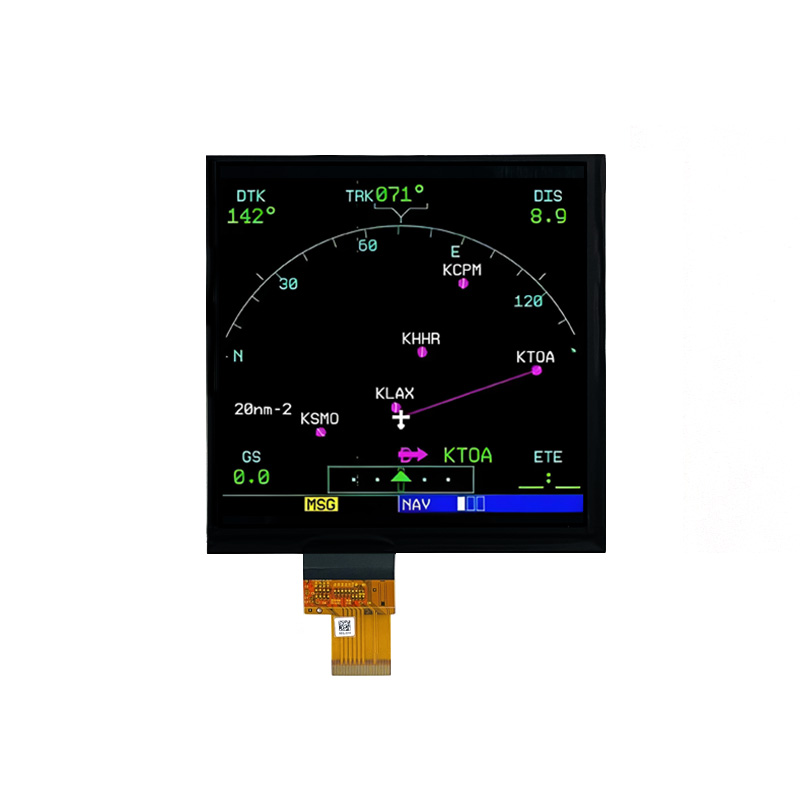
In flight simulators, square LCD displays are used across multiple areas:
Primary Instrument Panels: Rendering critical flight data such as altimeters, airspeed indicators, and attitude displays.
Navigation and Radar Displays: Balanced visualization of flight paths, terrain, and sensor information.
Modular Cockpit Panels: Multiple square displays can be integrated to replicate complex cockpit layouts, maintaining consistent visual presentation across the simulator.
System integrators often reference flight simulator display solutions to standardize panel layouts and maintain visual consistency across multiple modules. The square display format simplifies UI standardization, ensuring that trainees experience uniform instrument scaling and consistent interface responsiveness.
Instructor stations and auxiliary monitoring panels also benefit from these displays, providing accurate visual feedback for evaluation and supervision. Their predictable resolution and aspect ratio facilitate easier integration with embedded systems and monitoring interfaces.
Designing cockpit panels with square LCD displays requires attention to hardware and software integration. Standardizing layouts and UI designs across all modules improves consistency and reduces development overhead. Center-weighted interface layouts allow primary flight instruments to occupy central positions while secondary indicators are arranged peripherally, mirroring actual aircraft cockpit design and reducing trainee cognitive load.
Integrators can also utilize custom LCD display engineering services for project-specific adaptations such as orientation adjustments, specialized backlighting, or thermal enhancements. Early planning ensures compatibility with existing avionics systems, simplifies future upgrades, and maintains high reliability throughout the simulator’s operational life.
Proper grounding, cable routing, and thermal management remain key for maintaining stable electrical performance. By following these integration practices, designers ensure that square LCD displays provide long-term stability, high visual fidelity, and ergonomic advantages across training platforms.
Square LCD displays are a vital component in modern flight simulator cockpits, offering precise visual representation, mechanical simplicity, reliable electrical performance, and ergonomic benefits. Their integration enhances training realism, streamlines panel design, and ensures consistent performance over long-term operation, making them an essential choice for pilot training and avionics simulation programs.

